
9 Tools Every Remote Team Needs
Author
Lumin Staff
Published
May 10, 2024
Categories
Productivity
Read time
5 mins

Remote working has been gaining more popularity. It is estimated that by 2025 nearly half of the US labor force will, fully or partially, work on a remote basis. Europe and other regions are very likely to catch up with this international trend.
Table of contents
- 1. Challenges of Remote Working
- 2. Essential Set of Tools for Remote Teams
- 3. Remote Working Tools: Slack for Team Communication
- 4. Remote Working Tools: Time Doctor for Employee Time Tracking
- 5. Remote Working Tools: Google Drive for Organizing Folders
- 6. Remote Working Tools: Lumin PDF as a PDF tool for Remote Teams
- 7. Remote Working Tools: Zoom for Video Conferences
- 8. Remote Working Tools: Freshdesk to Tackle Customer Requests
- 9. Remote Working Tools: Timezone.io for Organizing Global Teams
- 10. Remote Working Tools: Trello for Project Management
- 11. Remote Working Tools: Zapier for Workflow Automation
- 12. Summary
Share this post
Moreover, apart from the values of digital nomadism and the tech-driven generations Y and Z, there are also factors such as the recent COVID-19 crisis, further contributing to the digitization of the workplace.
This article will explore some of the best work tools to organize remote operations smoothly and efficiently.
Challenges of Remote Working
Challenges surrounding remote workers’ time tracking to finding a reliable pdf editor and organizing a remote team raises questions like the following:
- How to control the employees if you can’t simply walk in the room and see what they are doing?
- Speaking of remote employee time tracking, how can we be sure that the performer is doing his/her work productively and not inflating the real time needed to complete a task?
- What are the best work tools to avoid document duplication and ping-ponging when there are many team members involved?
- Considering remote workers often live in different time zones, how can we keep everyone happy and make them feel involved?
- Is there a way to use fewer tools for remote teams and have more automation & integration?
These are just some of the major concerns that lead to hesitation on the part of employers from fully immersing their company into the remote model of work.
Essential Set of Tools for Remote Teams
Remote team collaboration is not only about organizing work and choosing the best work tools but also about building processes and the accommodation of employees’ needs. An effective system ensures that knowledge sharing and job satisfaction are coupled with the attainment of a company’s goals.
To reach maximum efficiency, it is also crucial to think about the processes, not only remote working tools. For instance, a video call involving 15 participants (instead of a simple email update) translates to 15 hours of paid, human work. Also, editing documents on a private PC and sending them from place to place, takes much more time than inviting team members to edit a shared document online.
The essential core instruments for setting up an efficient remote team include:
- Communication tools – interacting with team members is an essential component of any remote work structure, responsible for connecting people via email, video conferences, and chats
- Remote employee time tracking tools – this is especially applicable in sectors with hourly billing, where such tools can ensure fair project delivery
- Project management tools – organizing to-do lists, which can be accessed by all team members simultaneously, eliminates a big chunk of managerial routine bureaucracy, leading to better project delivery
- File management tools – moving text documents, spreadsheets and pdf files to cloud-service solutions can help structure the company’s paperwork to ensure simultaneous remote collaboration
- Other tools for remote teams – there are wide arrays of small yet useful apps that further simplify digital work coordination—e.g. time zone indicators and automation platforms for marketing and sales
Let’s take a closer look at some of the best work tools to cover many of the issues surrounding remote working.
Remote Working Tools: Slack for Team Communication
Slack is a chat platform for in-house collaborators that organizes workflow and communication into an easily accessible chat. It can be used from any device — be it a laptop, tablet, or a smartphone — thus facilitating discussions and file sharing.
Remote working with the help of Slack can be organized by project, team, or both. Apart from document exchange, there is also the possibility of screen sharing. All these features simplify the remote team interaction experience, making it feel as if everyone is sitting next to each other.
Slack also offers integrations with GitHub, BitBucket, and other online platforms. In fact, it is considered to be one of the best work tools for remote teams.
Remote Working Tools: Time Doctor for Employee Time Tracking
Time Doctor is a leading application for remote employee time tracking. Among its avid users, there are big tech names such as Apple, Verizon, PwC and Surveymonkey, to mention a few.
With the help of Time Doctor, managers of remote teams can keep track of billable time spent per task, project, or employee. These insights can further help them optimize the processes and introduce necessary improvements. Its integration with tools for remote teams such as Atsana, Jira, Zendesk, and Google Drive, further automates the navigation through the managed workload. To simplify billing, there is also an option to issue automated invoices and to automate the pay-put process with major systems, such as PayPal or Transferwise.
Although not all employers may feel comfortable with remote workers’ time tracking, Time Doctor also has some spying tools that can help judge an employees’ diligence and proper conduct, including:
- tracking of the browsing history
- randomly taken screenshots of the desktop
- reporting on any use of “distraction” applications, namely social media platforms
Remote workers’ time tracking can make some people feel uncomfortable. After all, a coffee break with small talk or a quick chat over WhatsApp may help refresh the attention span and allow for better concentration; however, It is up to managers and employees alike to meet halfway over this approach.
Remote Working Tools: Google Drive for Organizing Folders
Google Drive is a good alternative to a corporate server with possibilities of remote collaboration in various projects. It also allows users to organize the documents into folders (e.g. by function: legal, HR, finance, marketing, sales, product development) and share certain access rights (view or edit) with the team members directly involved.
In basic terms, it brings the major Microsoft Office tools to the cloud service, thus enabling collective file editing of written documents, data spreadsheets, and presentations. At the same time, there are some limitations. For instance, to work on a pdf file, one will need a pdf editor.
Remote Working Tools: Lumin PDF as a PDF tool for Remote Teams
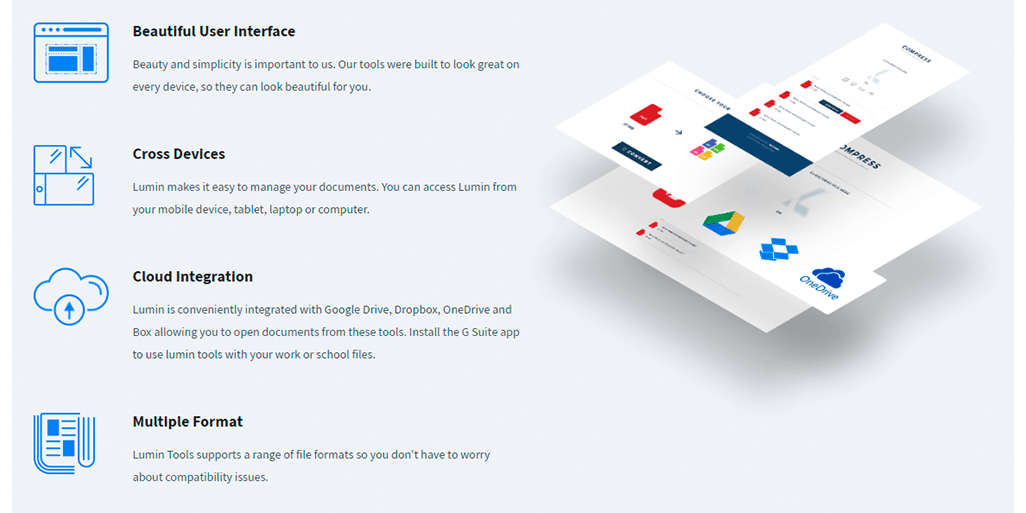
Lumin PDF is a popular cloud-based PDF tool for remote pdf editing. This advanced PDF editor allows remote workers to view, edit, annotate, comment, sign, and share pdf files via a browser extension or a mobile app.
Whenever Google Drive struggles to open a pdf document, there is an option (if you right-click) to open it in Lumin PDF. This recognition by Google underlines the high level of trust towards this PDF editor.
Having the auto-saving mode on and real-time sync with major cloud back up providers ensures that any document edited in the Lumin pdf tool is kept safe.
The key features of Lumin PDF editor are:
- Filling in and signing of business or private forms (there is a wide selection of free pdf forms to choose from) – no need to print out a document, fill it out by hand, sign, and scan it. Everything is done right in the browser.
- Remote collaborative file editing – team members who are invited to edit a certain document do not need to save dozens of versions and ping-pong them back and forth between each other before getting to the final result; everyone can contribute to files stored in the online pdf editor
- In-app chats – if an employee wants his manager to pay special attention to a particular paragraph, he/she can leave a note and tag his/her manager’s name, leading to instant discussion and edits.
- Organized teams – Lumin PDF tool provides an opportunity to save teams of emails for easier management of access rights.
- Multi-platform access – making final edits in an urgent project from a tablet right before taking a flight is possible thanks to the support of the major PC, tablet, and smartphone operating systems.
Remote Working Tools: Zoom for Video Conferences
Covid-19 has had a tremendous impact on Zoom. In December of 2019, it had just 10 million daily meeting participants. By March of 2020, this number has grown by 20 times. A month later, the video calls application has reached 300 million daily users, achieving an impressive capitalization of $50 billion.
Zoom is known as one of the best team collaboration tools for hosting video conferences with real-time messaging and file sharing. Participants can also share their screens simultaneously and co-annotate, thus reaching maximum interactivity during meetings.
Furthermore, the application is known for its enhanced level of security: all meetings are encrypted with role-based user security and password protection.
Remote Working Tools: Freshdesk to Tackle Customer Requests
Freshdesk is a plug-and-play software solution for managing customer support issues. Its key features include:
- Integrated dashboard of customer support tickets from multiple channels
- Simultaneous use of different channels of client communication: email, social media, phone, messengers
- Easy ticket assigning between team members for reaching maximum productivity and a better response rate — based on the workload, these assignments can take place automatically
- AI & ML modules for automating responses to some frequently asked questions
- Advanced analytics providing insights on both customer experience and support agent’s performance
Remote Working Tools: Timezone.io for Organizing Global Teams

Some teams, especially in the software development industry, have globally distributed teams. Having a web designer in India, a marketer in the UK and a project manager in San Francisco means that it is quite hard to find overlapping working hours, given time zone differences that can reach 12 hours or more.
Timezone.io is an application developed specifically to tackle the challenge of time zone differences in distributed teams. It shows which time zone each employee is working from as well as their working hours. Based on this information, it is much easier to find a slot for a meeting that would suit all participants.
Also, in this way, remote collaborators will feel more integrated and socialized, belonging to a team where they are heard. Better remote work organization with the help of tools for remote teams like Timezone.io eliminates the need to work at night to be more synched and eventually makes a positive impact on the employees’ wellbeing.
Remote Working Tools: Trello for Project Management
Trello is one of the best team collaboration tools for managing daily assignments. It is designed featuring boards with organized cards specifying current tasks. Each card has:
- Members
- Description
- Comments
- Attachments
- Reminders
- Color labels (categories)
- To-do lists (tick boxes)
It is then easy to justify the look of the dashboard using different filters – e.g. by a team members’ name, a category of tasks, or status. Moreover, some triggers and integrations can further automate project management. For example, you can set up that a card status shifts to “Completed” once someone ticks the last checkbox.
The best part is that the basic package for small teams is free!
Remote Working Tools: Zapier for Workflow Automation
The final chord in organizing remote teams would be an integrated dashboard for all workflow and apps used. Why switch between 10 tabs if all things can be synched for easy simultaneous use?
Zapier is a work automation application that integrates other apps for remote work and builds clear processes with automated data exchange between the apps.
Here is a simple example of such automation: if a new Gmail message has an attachment, it will be automatically saved to Dropbox, and the Slack user in charge will get a notification. This small routine task can be automated, and there are many others, too.
Currently, Zapier is integrated with over 2,000 apps, including some of the best team collaboration tools:
- Slack
- Time Doctor
- Google Docs
- Trello
- Zoom
- Dropbox
- SurveyMonkey
- Hootsuite
- HubSpot
- Shopify
Summary
Organizing remote teams can be quite challenging: from different time zones to performance supervision or file sharing. The good news is that there are plenty of tools available to help with all operational functions. The best team collaboration tools often give an opportunity to integrate and foster a smooth flow with other tools.
Slack and Zoom cover team communication and knowledge sharing needs. Google Drive and Lumin PDF resolve problems relating to shared document editing and storing. Trello satisfies the key project management requirements, and there is Time Doctor for remote employee time tracking.
In short, a few simple subscriptions can have a great impact on a remote team’s productivity and satisfaction.
Share this post