
What is a 1040 tax form? A guide for U.S. taxpayers
Our clear, beginner-friendly guide to IRS Form 1040 explains what it is, who needs to file it, and how it fits into the U.S. tax filing process.
4 [{"lang":"vi","url":"/vi/blog/mau-thue-1040-la-gi/"},{"lang":"es-es","url":"/es/blog/que-es-el-formulario-de-impuestos-1040/"},{"lang":"pt-pt","url":"/pt/blog/o-que-e-o-formulario-de-imposto-1040/"},{"lang":"fr-fr","url":"/fr/blog/quest-ce-que-le-formulaire-fiscal-1040/"}]You can also read this article in Tiếng Việt, Español, Português and Français.
Table of contents
- 1. What is a 1040 tax form?
- 2. Who needs to file Form 1040?
- 3. How to file IRS Form 1040
- 4. File your Form 1040 with confidence
Share this post
Launching into a new year also means getting ready for tax season, and for most Americans, that will include IRS Tax Form 1040. Over 100 million people filed a 1040 for the 2023 tax year, according to eFile.
Whether you’re brand new to tax filing or just need a light refresher, IRS Tax Form 1040 is one to be familiar with. Understanding what it is, who should use it and how to complete and file it will help you breeze through tax season.
What is a 1040 tax form?
Form 1040, officially called the U.S. Individual Income Tax Return, is a two-page form used by taxpayers in the U.S. to file individual annual income tax returns.
Form 1040 includes the following schedules:
- Schedule 1: Additional income and adjustments to income, like unemployment income or HSA contributions
- Schedule 2: Additional taxes like self-employment taxes
- Schedule 3: Additional credits, like child or education credits, and payments
Beyond the three main schedules, there are many specialized schedules, such as Schedule A for itemized deductions and Schedule B for interest and ordinary dividends. Your specific tax situation will determine which schedules you need to complete.
The deadline to file your 1040 for income earned in 2025 is April 15, 2026. If you file for an extension, the deadline is October 15, 2026.
You can find and fill out the 1040 tax form on Lumin.
What is on a Form 1040?
There are seven key sections on a Form 1040 to be familiar with:
- Personal information and filing status: This includes things like your name, social security number (SSN), address, date of birth, and whether you’re single, married filing jointly, married filing separately or head of household.
- Dependents: The name, SSN and relationship of any dependents.
- Income: Here you’ll report all wages and income, including retirement income, unemployment income, self-employment income, interest earned, dividends earned, etc.
- Deductions and adjustments: This section specifies whether you’re using the standard deduction or itemized deductions from Schedule A. If you have any adjustments, like HSA deductions, they will be listed here.
- Taxes and credits: Here you will see how your taxes are calculated, including any child tax credits and how they affect your tax liability.
- Payments: If you’ve made any estimated tax payments or qualify for the earned income credit (EIC) or American opportunity credit, those will be listed in this section.
- Refund: Using all the information gathered in the first six sections, the refund section will calculate the taxes you owe or will receive as a refund. If you’re owed a refund, you’ll also list your direct deposit information here.
What are the different types of 1040 tax forms?
There are four current types of 1040 tax forms:
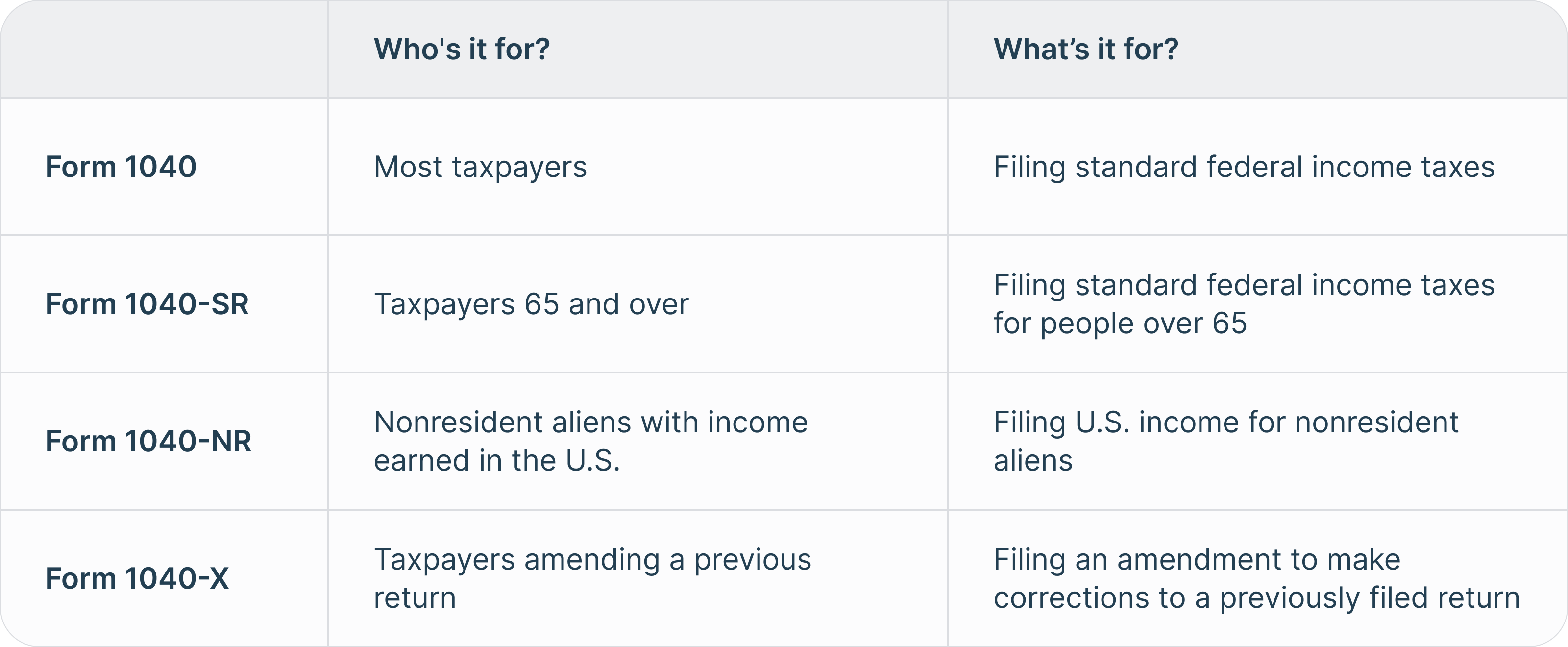
You may see references to a 1040A or 1040EZ, but the IRS has discontinued both forms.
Form 1040 vs W-2: What’s the difference?
Form 1040 is:
- A form used by taxpayers to report their federal income and taxes owed (or refund due)
- Prepared by the tax preparer
- Submitted to the IRS
Form W-2 is:
- An income statement that reports all annual wages and taxes withheld
- Prepared by the employer by January 31
- Submitted to you (employee), the IRS and the Social Security Administration
- Used in preparing your Form 1040
Who needs to file Form 1040?
If you are a U.S. citizen or a resident alien with earned income above certain IRS-specified thresholds, you’ll need to file a standard Form 1040. This includes self-employment income, investment income and rental property income.
Factors like filing status (single, married filing jointly, etc.), age and income amount determine your income threshold.
Are there times I should file a Form 1040 even if not required?
There are situations when it may be in your favor to file a 1040, even if you’re not required to, as you may be due a refund. Consider filing a 1040 anyway if:
- You earned any income with federal income taxes withheld
- You made estimated tax payments
- You qualify for tax credits
How to file IRS Form 1040
You can self-prepare and e-file Form 1040, or hire a tax professional to do it for you. In 2024, 44% of people e-filed their own returns, while 56% had their returns filed by a tax professional, according to Next Gen Personal Finance (NGPF).
Whether you self-file or hire a tax preparer to do it for you, the general steps to file are the same: Access required tax documents, choose your filing method and submit the return. If you owe taxes, you can send payment with the return. If you are due a refund, you can track your refund status once the IRS has accepted the returns.
File your Form 1040 with confidence
Filing your Form 1040, U.S. Individual Tax Return Form, shouldn’t feel overwhelming. With a bit of clarity and preparation, you can file your taxes with confidence, knowing you are compliant and paying what you owe and not a penny more.
Are you ready to file your 2025 taxes? Find the IRS tax form you need and complete it online quickly and easily with Lumin.

Share this post