
Securing digital agreements white paper
In a world where business relationships matter more than ever, Verified Digital Signing ensures every agreement is backed by genuine human identity, eliminating the uncertainty that slows down business and the vulnerabilities that put it at risk.
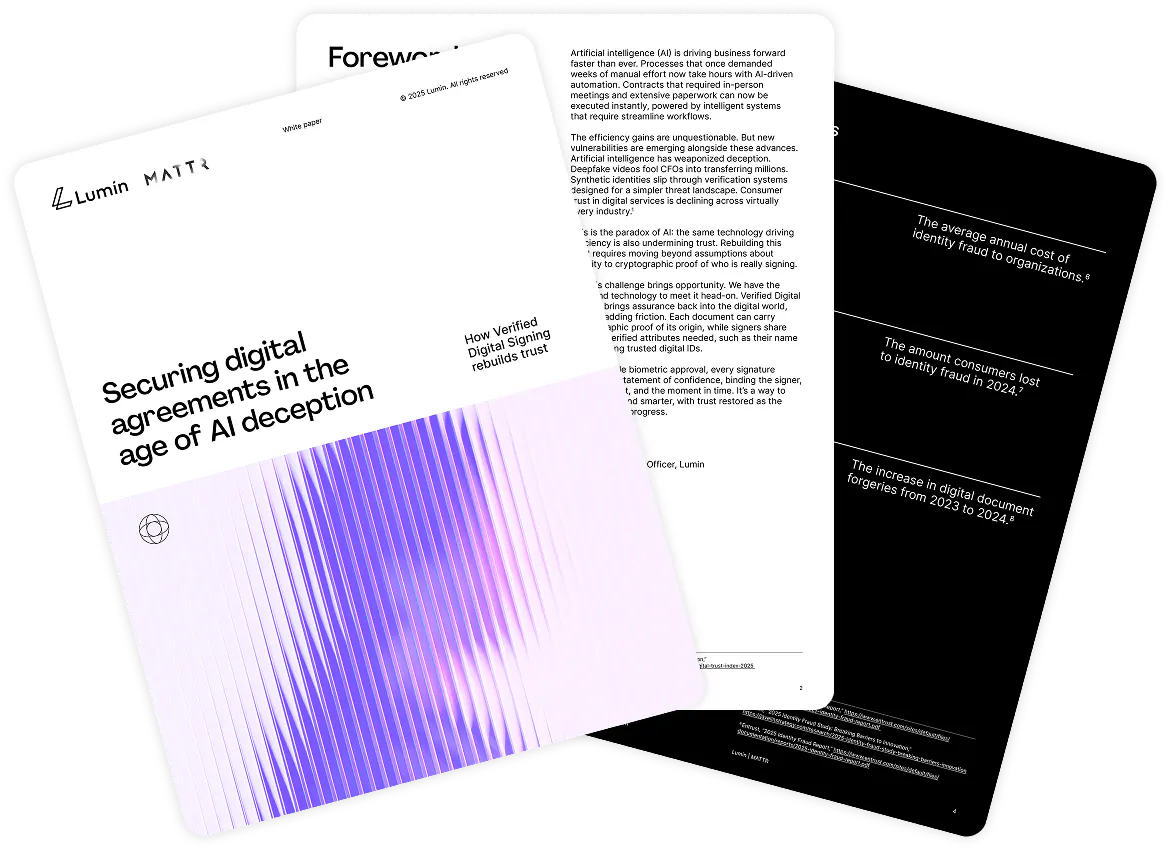
Download the white paper
Enter your details to access the full white paper and learn how verified identity authentication strengthens digital signatures, improves auditability, and builds trust in high-value agreements. We'll also keep you updated with early access invitations and news.

“Identity fraud is growing in both frequency and sophistication, costing organizations $7 million each year.”
Why Verified Digital Signing?
Eliminate signature fraud
On average, identity fraud costs organizations $7 million annually.

Streamline business processes
Transform complex workflows into smooth digital experiences with instant verification.

Stay ahead with Verified Credentials
Replace outdated KYC processes with verified, interoperable credentials.
Safeguard your reputation
Protect high-value deals and stakeholder relationships with digital trust infrastructure.
Lumin is trusted by 300+ Fortune 500 companies
Safeguard your business
Lumin Verified Digital Signing is SOC 2 Type 2 and ISO 27001 certified, trusted by Fortune 500 companies worldwide. Built on W3C and OpenID standards with government-backed cryptographic verification, our zero-knowledge architecture ensures enterprise-grade security, complete privacy preservation, and audit-ready compliance that meets the most stringent regulatory requirements.
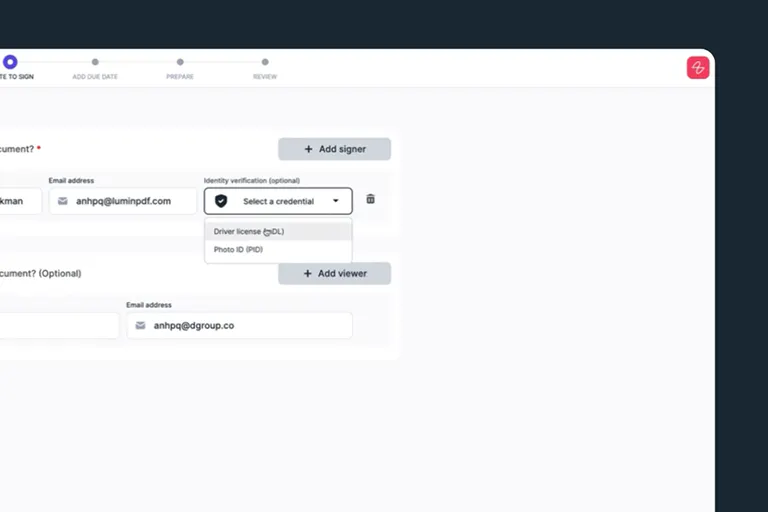
Send securely
Select ‘Identity verification’ as a requirement, this ensures the recipient signs with their verified digital credential.
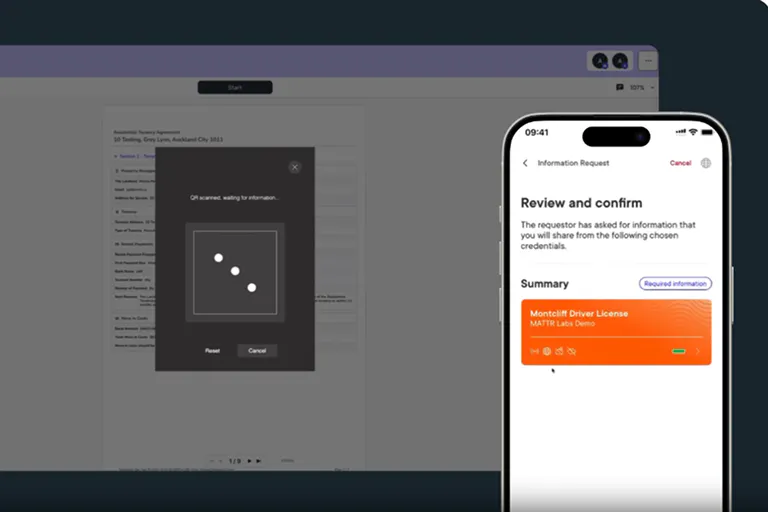
ID-Verified Digital Signing
The recipient scans a QR code and uses their government-issued digital credential to confirm their identity and sign.

Receive signed agreement
Once signed, the document is returned with cryptographic proof of the recipients verified signature using mDocs.
Industry-specific solutions
Designed for government agencies that need highly-trusted identity verification for citizen services and other official documentation. Meet compliance requirements while streamlining processes with cryptographic proof of identity that courts and auditors trust.

Designed for enterprises managing high-stakes contracts, employee agreements, and vendor relationships at scale. Eliminate identity fraud while accelerating deal velocity with verified digital signatures that protect your reputation and bottom line.

Designed for growing businesses that need to protect against identity fraud while maintaining efficient contract and employment processes. Get enterprise-grade security without enterprise complexity – verify every signature with government-issued credentials in seconds.

Designed for individuals who need to prove their identity for loans, leases, employment, and other important transactions. Use your government-issued credentials to sign with confidence, knowing your identity is cryptographically protected and instantly verifiable.

Frequently asked questions
A digital identity credential is a secure, government-issued form of identification — such as a mobile driver’s licence (mDL) or mobile document (mDoc) — stored digitally on your smartphone or within a secure mobile wallet. It serves the same function as a physical ID, allowing you to prove who you are in both online and in-person interactions.
Unlike traditional forms of identification, digital credentials are cryptographically secured and designed for privacy and efficiency. They’re often protected by biometric access (like fingerprint or facial recognition), making them harder to steal, forge, or misuse.Most standard digital signatures verify only that someone had access to an email address or device, not that they were the actual, intended signer. That means signatures can be reused, accounts can be compromised, and signers can later deny involvement.
Verified Digital Signing goes a step further by confirming who signed, not just that something was signed. It uses a government-issued digital identity credential to authenticate the signer before they can apply their signature. This adds a layer of cryptographic proof that connects the signature to a verified real-world identity.Lumin supports a growing number of digital identity schemes, including mobile driver licences (mDLs), mDocs, and other government-issued digital credentials.
These credentials are already being adopted across regions such as Australia, New Zealand, parts of the United States, Canada, and the European Union, with support expanding quickly as more governments and institutions roll out digital ID programs.