A qualification, a license, or an identity claim is easy to share digitally. Knowing what you can trust is harder, or verifying it is another matter.
Verification today often depends on manual checks of static documents. A PDF is emailed. A registry is searched. A phone call is made. Or the document is simply accepted at face value.
These approaches can work at low volume, but they are prone to breaking down quickly. Manual methods increase administrative overhead, introduce delays, and leave room for error or fraud. Over time, those gaps can erode customer trust.
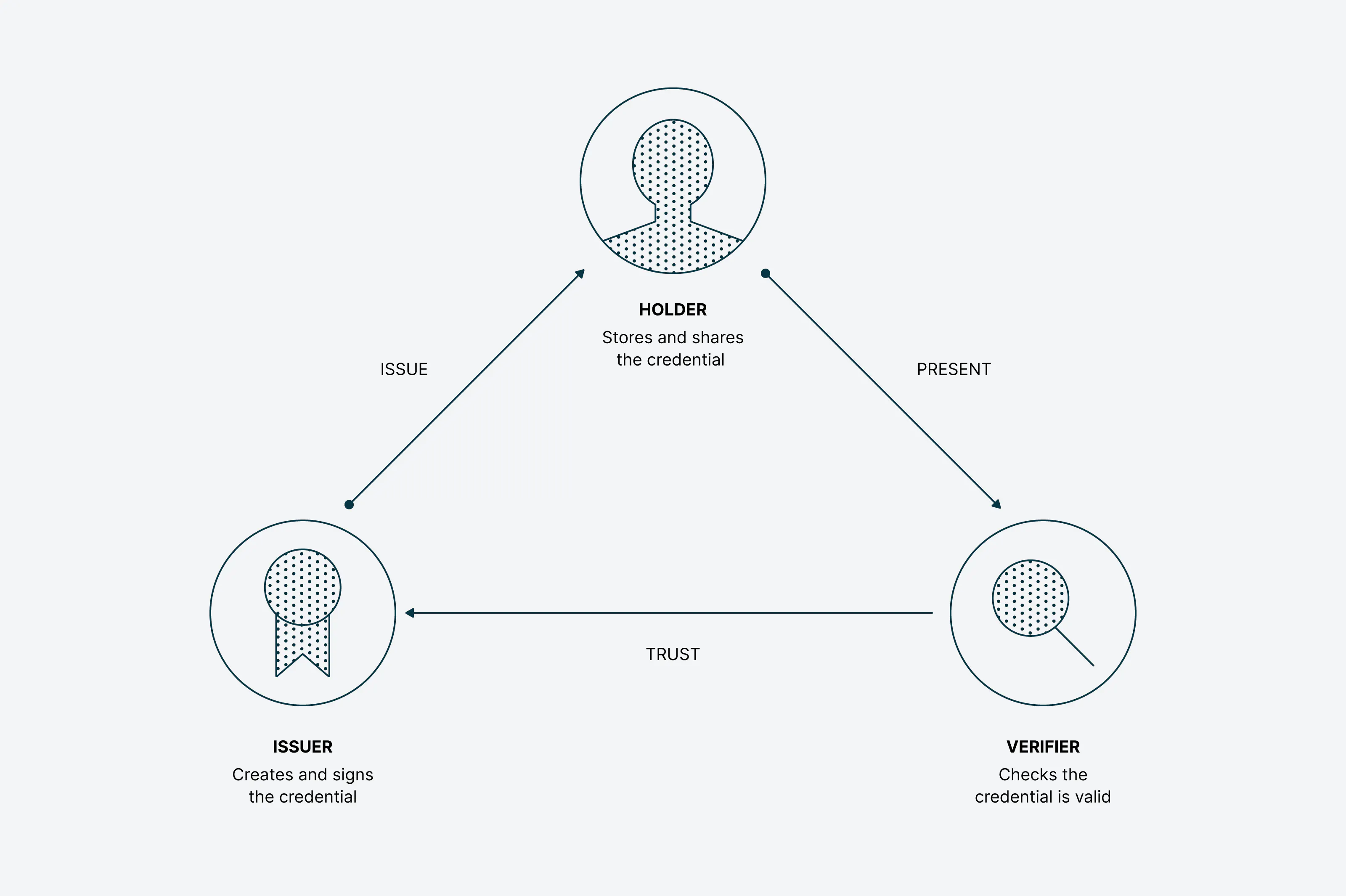
The trust triangle is designed to solve this problem. It defines who is responsible for establishing trust, and how that trust can be verified in a digital environment.
What is the trust triangle?
The trust triangle is a three-party model that underpins how digital credentials are issued, shared, and verified. It forms the foundation for verifiable credentials and decentralized identity systems.
The three roles of the trust triangle
It is called a triangle because each role connects to the other two, but each has its own distinct job.
- Issuer: the organization that creates and stands behind a credential, such as a government agency or accredited private organization.
- Holder: the individual or organization that stores and presents the credential.
- Verifier: the party that needs to confirm the credential
How verification works in the trust triangle
In the trust triangle, trust is built into the credential rather than recreated every time it's checked.
When an issuer creates a digital credential, it's sealed cryptographically so it can't be altered. When a verifier receives it, they can instantly confirm who issued it and that it's still valid, without going back to the issuer.
From there, it sits with the holder. They store it securely on their device, typically in a digital ID wallet, and decide when to share it.
When a verifier receives it, they don't need to start from scratch. They can check the signature and immediately see who issued it and whether it's valid.
There is no need to go back to the issuer to confirm anything. Verification becomes something that can happen instantaneously, rather than a process that has to be restarted each time.
For the holder, the experience shifts as well. Instead of relying on the issuing organization to vouch for them repeatedly, they can present their credentials when needed.
What does the trust triangle change for businesses?
In practice, the trust triangle model reduces onboarding delays, simplifies workflows, and reduces manual handling. It also makes verification more consistent. Rather than relying on judgment or varying processes across teams, the same checks can be applied each time.
Why the trust triangle matters now
As more interactions happen digitally, digital verification is moving closer to the center of how organizations operate.
The trust triangle offers a direct approach. Credentials can be verified in the moment, without repeated follow-up or reliance on third parties. It also shifts control. Individuals can present credentials themselves, when needed, without relying on issuing organizations to confirm them each time.